
Is My Child Lazy, or Could It Be Dyslexia? | WhyTheyThink Blog
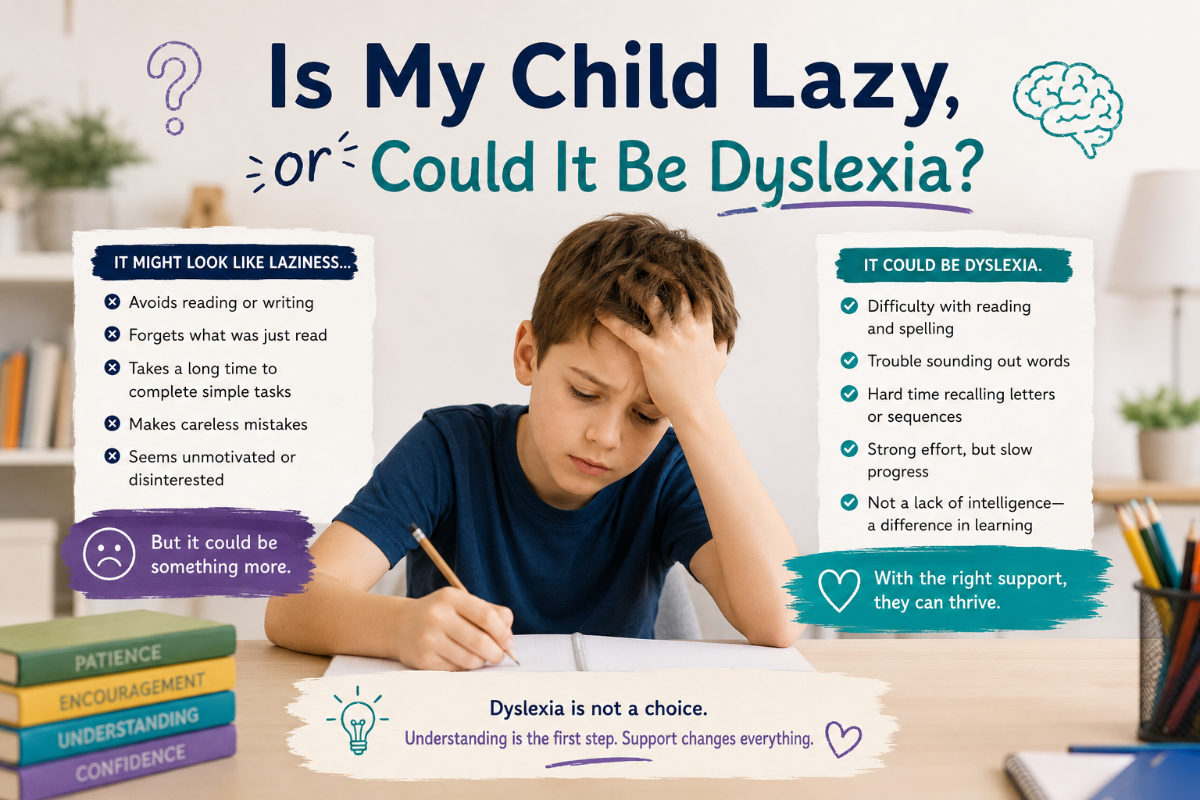
"He's just lazy." "She doesn't apply herself." "If she just tried harder."
If you've heard comments like this about your child, whether from a teacher, a relative, or even your own frustrated voice at the end of a long homework battle, you're not alone. It's one of the most common things said about kids who are struggling with reading and writing, and it's also one of the most misleading.
Because in a lot of cases, what looks like laziness is actually exhaustion. And what looks like not trying is often a child who has been trying very hard, for a very long time, at something that is genuinely much harder for them than it looks.
Why "lazy" is often the wrong word
Laziness implies a choice: a child who could do the work but is choosing not to. But when you look closely at kids who are labelled this way, a different pattern often emerges.
These are often kids who:
- Take much longer than classmates to do the same amount of reading or writing
- Avoid tasks not because they don't care, but because the task itself feels overwhelming
- Seem to "forget" how to spell words they got right last week
- Can talk brilliantly about a topic but freeze up when asked to write about it
- Find ways to get out of reading aloud, every single time
None of this looks like laziness from the inside. It looks like dread. And dread, especially the kind that builds up over months or years of feeling behind, often gets expressed as avoidance, which then gets misread as not caring.
The effort is invisible
One of the hardest things about dyslexia and similar learning differences is that the effort involved is completely invisible from the outside.
A child without dyslexia might read a paragraph and absorb it almost automatically. A child with dyslexia might be working incredibly hard just to decode each word, with very little brainpower left over for understanding what it actually says. By the time they reach the end, they're tired, and they may not even remember what they read.
From the outside, both children might produce similarly short answers to "what did you just read?" But one did it effortlessly, and the other did it through significant mental effort that nobody else can see.
This is part of why so many bright kids with dyslexia go unnoticed for years. They're often working two or three times harder than their classmates just to keep up, and because the effort doesn't show, it looks like they're not putting in any effort at all.
Some patterns that point beyond "just lazy"
If you're wondering whether there's more going on than motivation, a few patterns are worth paying attention to:
The gap between spoken and written ability. A child who can explain something in detail verbally, with good vocabulary and reasoning, but whose written work is short, simple, or full of errors, is showing a gap that's worth noticing. This gap doesn't usually show up if the issue is purely motivation.
Avoidance that's specific to reading and writing. Kids who are generally unmotivated tend to avoid effort across the board. Kids with dyslexia often work hard and engage enthusiastically in subjects that don't rely heavily on reading, like maths, art, building, or anything hands-on, while specifically avoiding reading and writing tasks.
Inconsistent spelling. A child who spells the same word three different ways in the same piece of writing isn't being careless. This kind of inconsistency is actually a fairly classic sign that the connection between sounds and letters isn't working the way it does for most people.
Reading that doesn't get easier with practice the way you'd expect. Most kids get noticeably faster and more confident readers with regular practice. If your child has had plenty of practice and reading still feels like a slog, with little improvement over time, that's worth paying attention to.
Physical signs of stress around reading and writing tasks specifically. Stomach aches before reading homework, meltdowns over writing assignments, or a sudden need for the bathroom right when it's time to read aloud. These reactions are often genuine signs of distress, not manipulation.
Why this matters
Beyond the practical impact on schoolwork, there's a bigger cost to the "lazy" label: it teaches kids that the problem is them. That if they just tried harder, cared more, or stopped being difficult, things would be fine.
For a child who has actually been trying very hard for years, this message can be deeply damaging. It can lead to a child who stops trying altogether, not because they've given up on reading, but because they've given up on the idea that effort makes any difference for them.
Reframing the picture, from "not trying" to "this is genuinely harder for my child than it is for other kids," can be a huge relief, both for the child and for the parents who've spent years feeling like nothing they try seems to help.
What to do next
If this is sounding familiar, a few starting points:
Notice the pattern without judgment, both your child's and your own. If you've been frustrated about "laziness," that frustration makes complete sense, and it doesn't mean you've done anything wrong. It just means the picture might need to shift.
Talk to your child's teacher about what they see, specifically asking about the gap between verbal and written work, and whether reading has become noticeably easier with practice or has stayed a struggle.
Consider a screening. Dyslexia and other learning differences often run alongside each other, and a broader picture can help you understand what's actually going on, not just with reading, but with attention, working memory, and other areas that often connect.
A different starting point
If "just try harder" hasn't worked, despite your child genuinely trying, it might be time for a different question: not "why won't they try," but "what's making this so much harder for them than it needs to be?"
Our free screening looks at reading, writing, and related areas alongside attention and other factors, and can help you start to answer that question. You can also read more about what dyslexia can look like if you want to understand the broader picture before deciding what to do next.
Related articles
- Twice-Exceptional (2e): What It Means to Be Gifted and Neurodivergent | WhyTheyThink Blog
Twice-exceptional (2e) individuals are both gifted and neurodivergent, often excelling in some areas while facing learning challenges. Learn what 2e means, signs to look for, and how to support them effectively.
- Why Does My Child Overreact to Clothing Tags? | WhyTheyThink Blog
Some children melt down over scratchy tags, tight socks, or noisy rooms and it's not defiance. Here's what sensory overreaction actually looks like and what might be behind it.
- How to talk to your child's teacher about ADHD | WhyTheyThink Blog
Talking to your child's teacher about ADHD concerns doesn't have to be uncomfortable. Here's how to prepare, what to say, and how to keep the conversation productive.